IPDXR –
Diagnostic Healthcare Platform
Diagnostic processes often involve multiple stakeholders, including laboratories, phlebotomists, doctors, and patients. These processes are frequently fragmented and inefficient.

Ipseity , Guntur
4 Months
Healthcare
Ipseity
Challenge
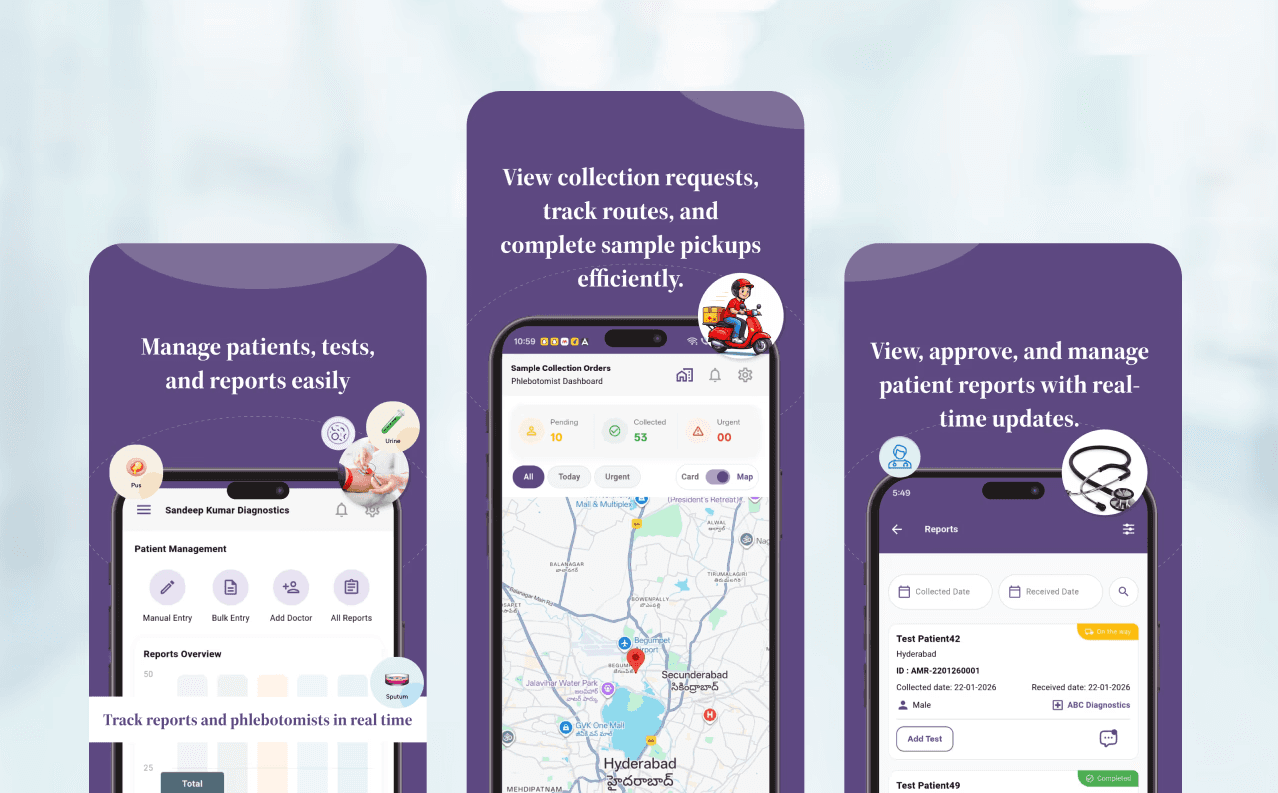
The primary challenge was designing a role-based system that supports multiple users with different responsibilities while maintaining a simple and intuitive interface.
Each user group required different features:
Patients needed easy test booking and report access
Phlebotomists needed clear sample collection workflows
Doctors required quick access to diagnostic reports
Laboratories needed efficient test and report management
The challenge was to create a unified platform that simplifies complex healthcare workflows.
Results
The IPDXR platform simplified the diagnostic process by connecting multiple healthcare stakeholders into a single system. The structured dashboards and streamlined workflows improved accessibility to medical reports and enhanced coordination between labs, phlebotomists, and doctors.
The platform provides a more efficient and organized diagnostic experience for both healthcare professionals and patients.
35%
Improved onboarding process
25%
Increase in user retention
84%
Increase in time spent on website

Process
Research & Analysis: To understand the system better, I explored diagnostic lab workflows and healthcare management platforms.
Key Insights
Diagnostic workflows involve multiple users with different needs
Doctors require fast access to reports for consultations
Clear status tracking improves workflow efficiency
These insights helped shape the role-based UX structure of the platform.
User Flow: The platform was designed around multiple user journeys.
Patient Flow:
Register or log in
Book diagnostic test
Track sample collection
View and download reports
Phlebotomist Flow:
Receive test collection request
Navigate to patient location
Collect sample
Update sample status
Doctor Flow:
Access patient reports
Review diagnostic results
Use insights for consultation
Lab Flow:
Manage incoming test requests
Process samples
Upload diagnostic reports
Wireframing & Prototyping: We designed low-fidelity wireframes to visualize the new layout and navigation, iteratively refining them based on user feedback. Afterward, we built a high-fidelity, interactive prototype to test the design.
Usability Testing: We conducted usability tests with a diverse group of users to validate the design and identify areas for improvement. Based on the feedback, we made necessary adjustments to the design.
Visual Design & Style Guide: The interface was designed to create a trustworthy and structured healthcare experience.
Design highlights:
Clean medical UI
Role-based dashboards
Clear status indicators for sample collection
Structured report viewing interface
The design prioritized clarity, accessibility, and ease of navigation.






“Keerthana’s UX design helped simplify complex diagnostic workflows into a structured and easy-to-use platform. Her role-based interface significantly improved the usability of our healthcare system.”
Sravan kumar
— Product Team, Ipseity


Conclusion
Designing IPDXR helped demonstrate how UX design can simplify complex healthcare ecosystems. By focusing on role-based workflows, clear information hierarchy, and structured dashboards, the platform delivers an intuitive experience for managing diagnostic services.